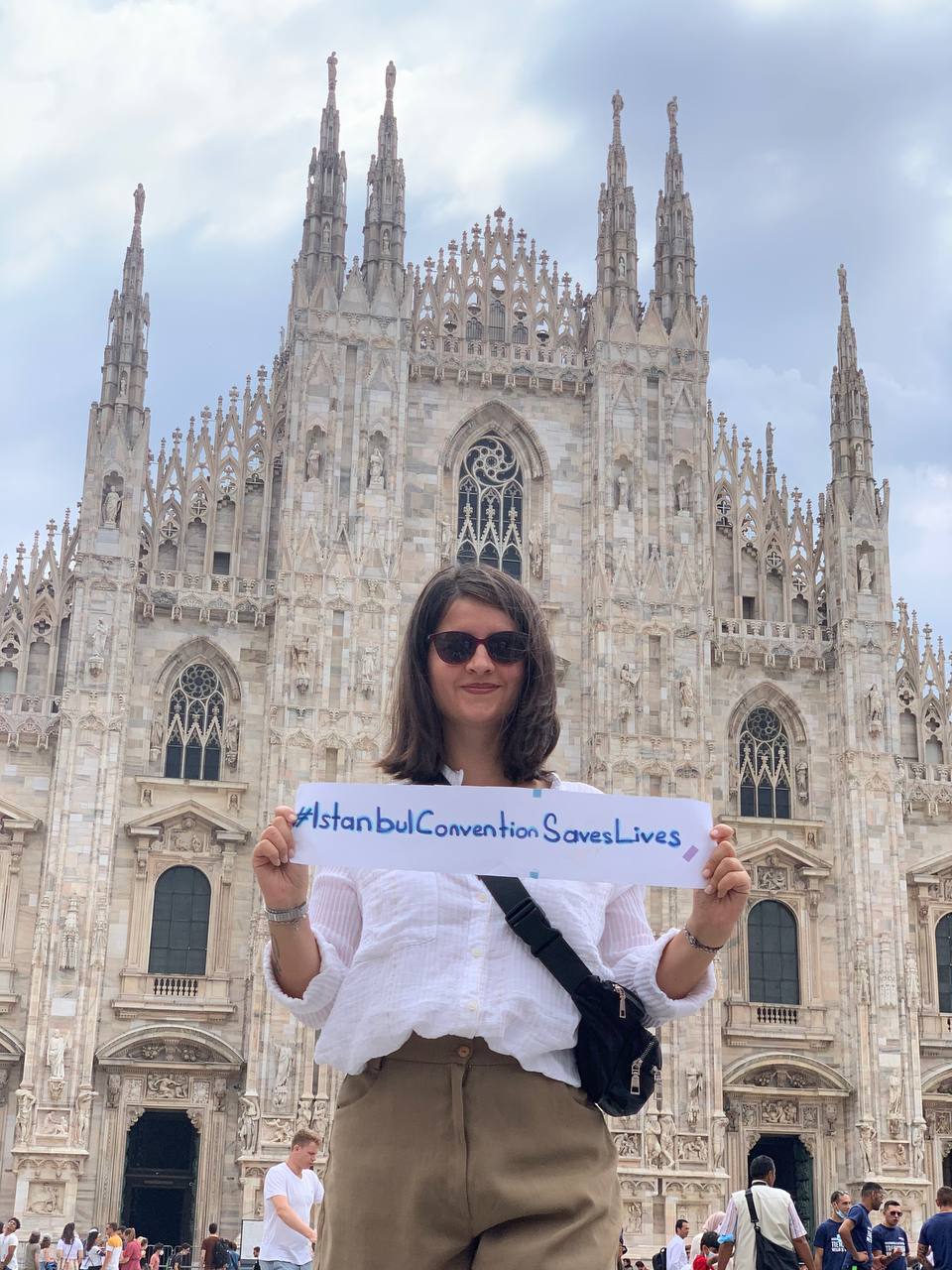
Istanbul Convention Saves Lives, saying it once again. Spreading one message in 12 countries, 15 cities, and in 10 different languages. Also what matters is quality rather than quantity!
Istanbul Convention… You hear it on the news, you see it in the newspapers. Maybe you are familiar with, maybe you have no idea about it. While thousands of women are shouting that the Istanbul Convention Saves Lives; maybe some questions come to your mind. Firstly; let’s understand and analyze it. Secondly, let’s advocate it together.
What is the Istanbul Convention? The Istanbul Convention is a human rights treaty. It is the Council of Europe Convention on preventing and combating violence against women and domestic violence. It was opened for signature on 11 May 2011, in Istanbul, Turkey. (We’ll come back to this later on.)
The Istanbul Convention recognises violence against women as a violation of human rights, and a form of discrimination against women.
It has been signed by 45 European states; and the EU as a whole and ratified by 35 of them. Bulgaria, Hungary, Czechia, Latvia, Lithuania and Slovakia did not ratify the Istanbul Convention; nor has the UK. Poland has taken steps to withdraw from the convention; citing an attempt by the LGBTQI+ community to impose their ideas about gender on all society. Furthermore; Turkey became the first and only country to withdraw from the convention on similar reasons.
What the Istanbul Convention says actually:
The state has a responsibility to prevent all forms of violence against women; protect those who experience it and prosecute perpetrators.
The state must promote equality between women and men and prevent violence against women by encouraging mutual respect or non-violent conflict resolution and questioning gender stereotypes. Including through teaching materials in schools.
Those who experience violence should have information and access to support services; such as 24/7 telephone helplines, rape crisis centres, counselling and shelters.
The state must investigate allegations of violence and prosecute perpetrators.
The state must protect and support those who experience violence. For example; by removing perpetrators from the house to make sure the person affected stays safe; and by offering sufficient and accessible shelters.
Police and justice system professionals should be trained on victims’ rights and how to prevent further harm. So that they are able to respond to calls for assistance and manage dangerous situations.
The state must ensure that victims can claim compensation from the offender and must award adequate compensation itself; if it cannot be covered from other sources.
The state must ensure a coordinated approach among all relevant agencies, civil society organisations and other stakeholders to support those who experience violence and protect them from further violence.
Civil society plays an important role in providing essential services to those who experience violence, raising awareness and helping to change attitudes to create a culture of zero tolerance.

Why do we have to mention that “Women’s rights are human rights!”
Violence against women and girls is among the “most widespread human rights violations” in the world. It is estimated that worldwide one in three women are subjected to physical or sexual violence by an intimate partner, or sexual violence from a non-partner during their lifetime. (Resource: UN agencies). Today, this is more important than ever before; as violence against women and girls has increased globally due to pandemic. It is a global emergency that requires urgent action at all levels; in all spaces and by all people. Ensuring survivor’s access to justice, dissuasive penalties; and the full and effective implementation of the laws can help change the culture that enables violence.
In other words, national measures alone are not sufficient. As a binding international treaty it sets the highest standards for combating violence against women. Certainly, the Istanbul Convention is a powerful legal instrument to combat gender based violence. That is to say; we want the governments to implement conventions and laws within the framework of women’s policies.
Turkey: The first country to sign the Istanbul Convention on May 2011; however, became the first and only country to withdraw from it.
Withdrawing from the Istanbul Convention means reversing the promise given to combat violence against women in the international arena, and not recognizing the state’s obligations in combating all kinds of violence and condemning women to violence.
All over the world and in Turkey; combating and preventing violence against women and girls is only possible with policies that aren’t excused by discriminating women, protecting them against violence, holistic and implementing severe punishments against the perpetrators. In other words; a country’s culture and traditions must never be used as an excuse for femicides.
A single message -by collective thinking and individual action
I’m offended that me and my rights are being ignored just because of my gender. I’m so angry with those who abuse their power. Those who deliberately cause evil and hurt people… I am so sad that people get hurt every day because of gender-blind policies. Nonetheless, I know that I’m not alone on this road. Lastly, and most importantly, every single person should know that I won’t leave anyone alone either.
Finally, here I am in all around Europe with a message. I am in Milan, Cologne, Valencia, Vienna, Budapest, Banská Štiavnica, Prague, Krakow… Barcelona, Leipzig, Copenhagen, Las Palmas de Gran Canaria, Brussels, Berlin, Paris, and Istanbul. The message I’m spreading is in 12 countries, 15 cities, and in 10 different languages is; Istanbul Convention Saves Lives. Istanbul Convention is ours and we won’t give up on it. Again, if the governments implement the treaty, Istanbul Convention Saves Lives.
Here is the video I was recorded in all around Europe:
P.S.: The banner was written during an Erasmus+ project in Bulgaria. You can read the story where many young women from around the world highlighted universal sisterhood here.
P.S. 2: I’d like to thank all my friends who supported me while making these videos. Solidarity keeps us stronger. Huge thanks to:
Sakthi (Milan), Roqia (Cologne), Lucia (Valencia), Melisa (Vienna), Lale (Budapest), Daniel (Banská Štiavnica & Krakow), Pavel (Prague), Maurizio (Barcelona), İlknur (Leipzig), Emma (Copenhagen), Rita (Las Palmas), Tamara (Brussels), Vuong (Berlin), Emma (Paris), Diana (Istanbul)